Q4 2025 Marketing Benchmark Report: Trends and Opportunities
As Q4 draws near, marketers are preparing for the most competitive and high-stakes period of the year. But behind the noise of seasonal campaigns, a clear set of behavioural patterns is emerging — patterns that reveal how brands are spending, how confident they feel, how deeply they’ve integrated AI, and what obstacles they expect to face.
We analysed the responses from marketing leaders across retail, beauty, lifestyle, and food categories. The insights below offer a grounded, data-backed view of what to expect this Q4 — and how the most adaptive teams can get ahead.
Marketers Are Spending — and Staying in the Game
.png)
Across industries, one theme stands out: brands are not pulling back this Q4. In fact, 84.6% of respondents are either maintaining or increasing their ad budgets. Half are increasing spend, half are holding steady, and only a small minority — just 15.4% — are cutting back. This is in tandem with the survey revealing a generally optimistic outlook for Q4, 2025.
.webp)
Strong Confidence in Achieving Targets: 46.15% of respondents are highly confident (rating 7+) in achieving Q4 2025 revenue targets.
Peak Confidence at Mid-High Levels: The most frequent responses, at 23.08% each, were concentrated at confidence levels 6 and 8, suggesting strong positive sentiment.
Lower Confidence Responses: While overall sentiment is positive, 30.77% of respondents reported lower confidence (5 or below), indicating minority concern.
This behaviour reflects a market that understands one thing clearly: visibility matters more now than ever. With demand softening and competition rising, pulling back would mean losing ground. As a result, Q4 auctions across Paid Search, Meta, and TikTok are expected to tighten, CPAs to rise, and creative performance to play an even bigger role in cost efficiency.
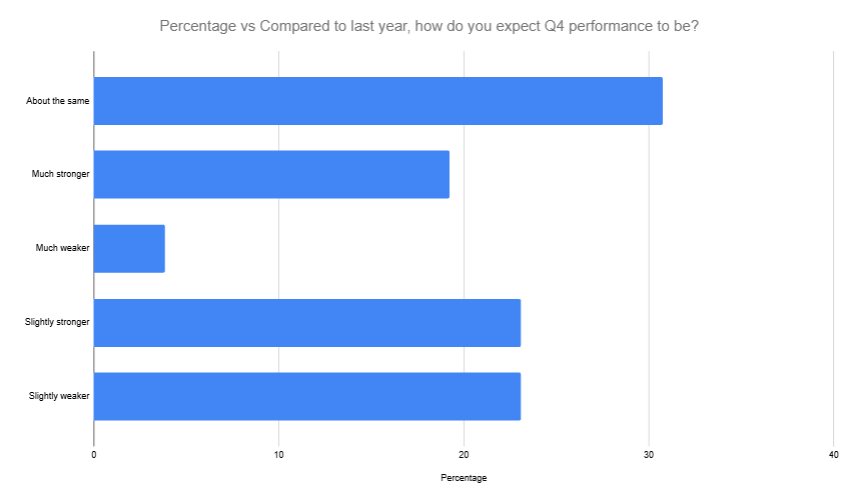
What we want to find out is that even though, confidence level is generally positive and high among the surveyed. Spend direction doesn’t always equal confidence. The sentiment around Q4 performance is strikingly balanced:
- 30.8% expect performance to remain similar to last year
- 23.1% expect slightly stronger outcomes
- 23.1% expect slightly weaker outcomes
- 19.2% are anticipating a significantly stronger Q4
- Only 3.8% foresee a much weaker quarter
This equilibrium reveals a grounded mindset. Marketers recognise that success won’t be guaranteed by macro tailwinds — it will be earned through strategy, execution, and adaptability. Q4 is shaping up to reward teams that can move quickly, test smarter, and interpret signals accurately.
The Quiet Evolution: AI as Marketing's New Operating System
One of the strongest shifts emerging this year is the role AI now plays in day-to-day marketing execution.
.png)
The majority of respondents report active AI usage across three main areas:
- 31% for creative (copy, visuals, assets)
- 31% for analytics and reporting
- 24.1% for media buying optimisation
- Only 13.8% are not using AI at all — a drastic reduction from previous years.
This signals a fundamental transformation: AI is no longer an “add-on” to the marketing tech stack. It has become the underlying infrastructure that fuels speed, volume, and decision quality. Creative iterations are faster, insights are clearer, and optimisation is becoming more automated. Teams still resisting AI are now noticeably slower.
The Biggest Obstacle This Q4 Isn’t Logistics — It’s the Consumer
Perhaps the most meaningful insight from the data is what’s slowing down Q4 growth. It isn’t supply chain disruptions. It isn’t policy changes. It isn’t platform instability. It’s consumer hesitation.
Half of all respondents cite weak consumer demand as their biggest challenge this season. Rising CPAs come second at 34.6%, reinforcing the pressure of increased competition.
.png)
The data reveals a clear frontrunner: 50% of marketers cite weak consumer demand as their #1 challenge.
This is followed by:
- Rising CPAs — 34.6%
- Supply chain issues — 15.4%
- Regulatory limitations — 3.8%
Consumers are:
- browsing more
- comparing more
- converting slower
- reacting only to strong value, proof, and trust signals.
This feeds into a new Q4 reality: demand must be created, not just captured. Full-funnel strategies, retargeting sophistication, and high-clarity value communication will be essential for turning slow-moving shoppers into buyers.
The Q4 Narrative: Competitive, AI-Powered, and Consumer-Driven
When viewed together, the data points create a clear, cohesive narrative about where Q4 is heading:
- Budgets are rising or stable, signalling an aggressive market.
- Confidence is cautious but controlled, meaning performance will hinge on strategic excellence.
- AI is now a foundational part of marketing operations, accelerating creative and analysis cycles.
- Consumer behaviour is the main friction, not supply-side issues.
- Winning teams will need to warm intent early, streamline creative production, and optimise relentlessly.
Q4 2025 won’t reward brands that simply spend more — it will reward brands that spend smarter, move faster, and communicate value more convincingly.



23.png)