Why Black Friday Keeps Starting Earlier - And What SEO + AI Reveal About 2025 Shoppers
Black Friday has shifted from a weekend event into a multi-week season - and it’s not slowing down. In 2025, early discounting has become normal, with major retailers launching offers in late October or the first week of November. This shift isn’t random; it is supported by clear consumer behaviour data, economic pressures, platform dynamics, and AI-driven optimisation patterns.
Below is a short, insight-led breakdown of why Black Friday is moving earlier, what that reveals about shoppers, and how brands can respond using SEO and AI together.
1. Search Interest Rises Earlier Every Year
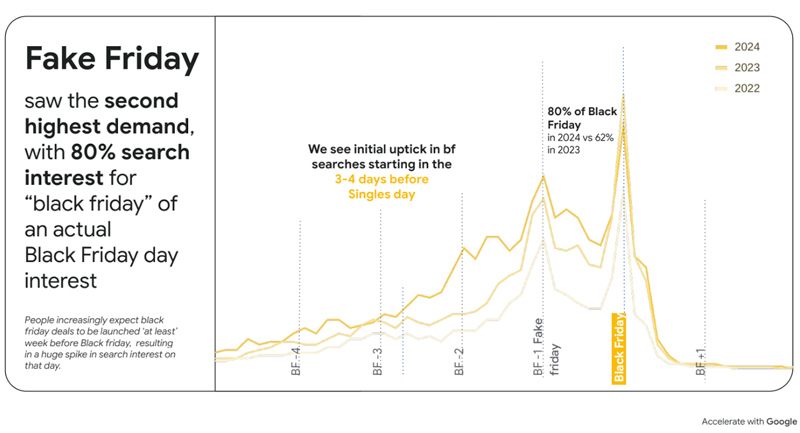
Boston Consulting Group’s 2025 Holiday Outlook reports that 60% of consumers start researching before November even begins, and nearly a third already know what they plan to buy by early November.
Consumers are planning to be strategic during this year's year-end sales to maximise value, despite widespread concerns over rising prices. Eighty-one percent (81%) of consumers cited worries about the cost of essentials, and 71% were concerned about tariff-related price increases.
The survey suggests that successful retailers will distinguish themselves by:
- Securing visibility within GenAI-driven ecosystems.
- Engaging shoppers early.
- Delivering clear and credible deals.
Consumer shopping habits are showing increased planning:
- A significant 77% of consumers report deliberately delaying purchases earlier in the year to take advantage of Black Friday and related promotions.
- Nearly 60% of shoppers start their deal research in October or early November.
- Nearly 31% enter the sales period knowing the exact brand and product they intend to buy.
- However, 28%—a slight increase from 2024—still rely on finding last-minute opportunities.
Early consumer behavior directly impacts SEO: brands must secure early visibility in search results. Failure to do so means missing the critical consideration window that opens when consumers initiate their search.
This indicates a shift: consumers are no longer waiting for the traditional "big weekend." They are proactively researching, comparing, and building wishlists well in advance. For brands, the buying journey now starts long before Black Friday, making early visibility more crucial than the timing of the discount itself.
2. Consumers Need More Time to Evaluate Value

With inflation and budget-conscious shopping, people compare more, plan earlier, and seek reassurance before committing. Refinitiv’s 2025 retail report notes that shoppers are “deliberate, methodical, and discount-aware”, not last-minute impulse buyers. Similar to Google’s 2025 Holiday report, consumers are researching earlier with intentions via AI and other social media platforms.
3. Rising Ad Costs Push Retailers to Start Earlier
However, consumer behavior is only half the picture; advertising economics also play a significant role. As demand peaks in mid-November, CPCs and CPMs on advertising platforms increase sharply. Refinitiv analysis shows that competition for audience attention causes ad costs to surge by 18%–42% in the two weeks leading up to Black Friday.
Starting early isn’t just a marketing choice anymore — it’s a cost advantage. Brands that wait until the peak pay more and benefit less, while early movers secure cheaper clicks, more stable reach and stronger learning signals for their AI-driven campaigns.
4. AI itself has reshaped how Black Friday works
Modern ad platforms like Google Performance Max and Meta Advantage+ rely heavily on machine learning. They need time — days or weeks — to identify the right audiences, optimise bidding strategies and adapt creatives. When brands launch at the last minute, AI doesn’t have a meaningful learning window, resulting in higher costs and weaker performance. But when brands begin earlier, they give AI the space to understand demand patterns and optimise with precision. Early signals become a competitive advantage.

Generative AI is transforming shopping, with 38% of U.S. consumers already using it for tasks like product research and personalized recommendations, and 52% planning to use it this year. AI-driven shopping traffic from Large Language Models (LLMs) has surged by 4,700% in the last year (as of July 2025). While still minor in total commerce, these early AI adopters are crucial for e-commerce's future.
5. Retailers want to reduce Black Friday Pressure
Retailers have learned that spreading sales across several weeks reduces pressure on everything from warehouses to customer service. A single 48-hour sales spike creates logistical chaos — stockouts, delayed deliveries, overwhelmed support teams. A phased Black Friday gives brands operational breathing room, and combined with AI forecasting, helps them predict demand far more accurately.
So What Should Brands Take Away for 2025?
Brands can’t rely on a late November push anymore.
Early visibility and early optimisation now decide who wins Black Friday.
The entire retail ecosystem — consumers, search engines, AI systems, and logistics operations — has shifted earlier.
The brands that dominate 2025 will be the ones who recognise that:
- SEO is now the gateway to early intent
- AI is the engine that drives adaptive performance
- Early campaigns are cheaper, smarter, and more stable
- Black Friday is no longer a weekend — it’s a season
Black Friday is getting earlier because the customer journey is starting earlier.
Brands must follow the consumer, not the calendar.



23.png)