Content marketing hit a 12-year low the same year 92% of teams adopted AI. Those aren't the same finding.
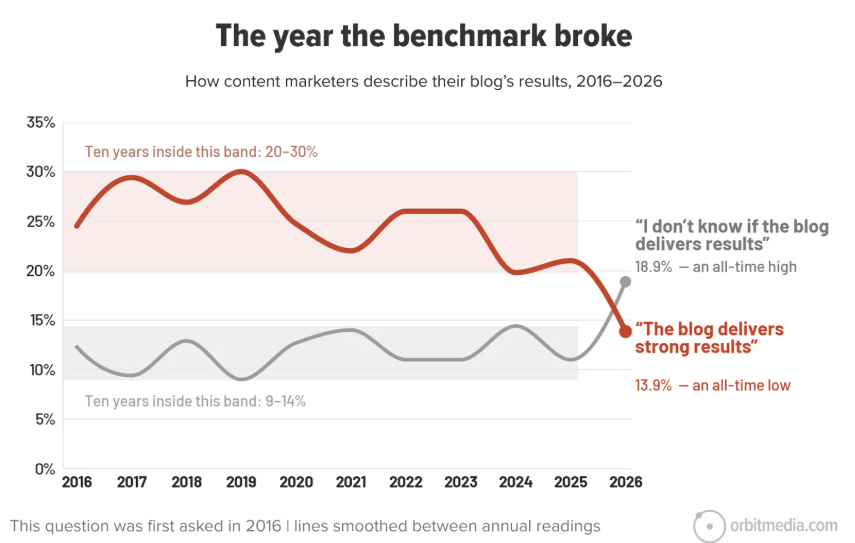
A recent surver showed content marketers about their blogging every year since 2014. The 2026 edition, with 1,042 respondents, produced the worst result in the survey's history: 13.9% report "strong results" from their content. In 2022 it was 26%. Across the previous decade the figure never dropped below roughly 20%.
The same survey found 92.4% of marketers now use AI in their content process — up from essentially zero three years ago.
Put those two numbers side by side and the headline writes itself: AI killed content marketing. It's tidy, it's plausible, and the survey's own data doesn't support it. Orbit's analysis is blunt on this point — AI use "correlates with nothing" when it comes to results. Teams that use it heavily and teams that don't report the same outcomes.
So something else fell. Here's what.
What teams stopped doing
The survey tracks a set of practices year on year. The ones that declined most sharply in 2026 are, almost exactly, the ones that correlate most strongly with strong results:
- Influencer collaboration — 25% of marketers in 2017, 7% now. The most-abandoned tactic in the survey. Teams that still do it are 2.6 times more likely to report strong results than the benchmark.
- Guest blogging — down 29%.
- Paid content promotion — declining, despite correlating with strong results. Orbit's own summary: the strategies that correlate with strong performance are all on the decline.
- Original research — publishing your own data, rather than summarising someone else's. Declining, and one of the strongest correlates of success.
- Keyword research — declining. The practice that connects content to demand.
- Formal editing — declining. Content with a human editor is nearly twice as likely to perform as content edited by AI.
- Analytics review — declining. Fewer teams are checking whether any of it worked.
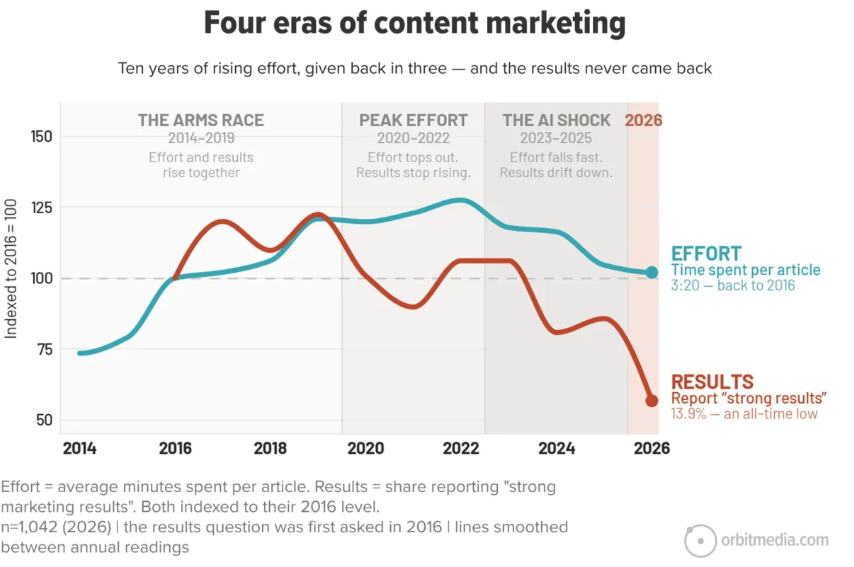
Read that list again. Every item is effort that sits outside the drafting step. Research before writing, editing after, distribution beyond publishing, measurement afterwards. AI made the middle step — producing a draft — dramatically faster. Average time per post fell from a peak of 4 hours 10 minutes in 2022 to 3 hours 20 minutes now.
And results fell with it. Speed was bought by cutting the work around the draft, and the work around the draft was where the results came from.
The measurement problem underneath
There's a second finding in the survey that explains why teams didn't notice.
Traffic is the most-tracked content metric — 39% of marketers use it as their primary measure. Among that group, only 11% report strong results, below the already-low 14% benchmark. Teams measuring on CRM data — qualified leads, deals, revenue — do considerably better.
This is Goodhart's Law applied to a blog. When traffic is the target, content drifts toward whatever generates sessions: broad topics, definitional explainers, high-volume keywords with no commercial connection. That content was already vulnerable to AI Overviews and zero-click search. So teams optimising for traffic watched the number fall, concluded content had stopped working, and cut the practices that would have told them otherwise.
Nearly 19% of respondents now say they're unsure whether their blog delivers results at all. Historically that figure sat between 9% and 14%. The uncertainty spike is the analytics-review decline showing up in the data.
The B2B baseline says the same thing
Content Marketing Institute's B2B research, fielded mid-2025 with 1,015 B2B marketers, gives the calmer version of the same picture. 59% rate their content marketing at least "somewhat effective". Only 12% call it highly effective. Among the effective teams, 65% credit content relevance and quality, and 53% credit team skills and capabilities.Nobody in the effective group credited producing more, faster.
What this means if you own a content budget
Two conclusions, and they pull in opposite directions from the "AI killed content" reading.
First: don't cut the content programme. Cut the drafting-only version of it. A team that uses AI to draft and then skips research, editing, promotion, and measurement is doing the part that doesn't correlate with results and skipping the parts that do. The fix isn't less AI. It's putting the effort back where it was.
Second: the practices that still work are the ones that are hard to automate. Original research requires you to have data. Influencer collaboration requires a relationship. A human editor requires judgement about what the piece is for. Keyword research requires knowing your commercial intent well enough to choose. These are the activities a competitor with the same AI tools can't replicate by prompting harder, which is precisely why they're now differentiating.
We've made a related argument before: top-of-funnel content didn't die, its job changed. This survey adds the mechanism. The job changed, and most teams responded by doing less of the job.
What to do this week
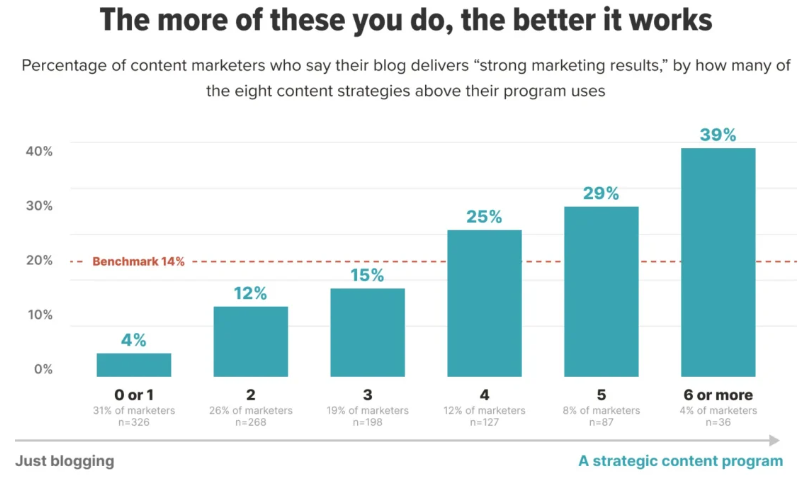
1. Audit which practices you've dropped. Orbit tracks eight; the ones it names as correlating with results include keyword research, original research, influencer collaboration, paid promotion, a formal editing process, visual content, and faithful use of analytics. Teams using six or more of the eight are nearly three times as likely to report strong results. Count yours honestly.
2. Change the primary metric. If your content report leads with sessions, move qualified leads, assisted conversions, or revenue-attributed pages to the top. Traffic can stay as a diagnostic. It shouldn't be the target.
3. Put a human editor back in the chain. Not a proofreader — an editor who asks what the piece is for and cuts what doesn't serve it. This is the single practice with the clearest performance gap in the data.
4. Commission one piece of original research this quarter. A survey of your customers, an analysis of your own order data, a benchmark from your category. It's the most-cited, most-linked, most-defensible content type left, and almost everyone has stopped producing it.
5. Reinvest the time AI saved. If drafting takes 50 minutes less per post, that's 50 minutes for research before and promotion after. The survey suggests that's where it went missing.
FAQ
Does this mean AI content is bad for SEO?
Not in itself. The survey found no correlation between AI use and results in either direction. Unedited, unresearched, unpromoted content performs badly whether a person or a model drafted it. AI just made it much easier to produce that kind of content at volume.
Is a 12-year low really about content, or about search changing?
Both. AI Overviews and zero-click results have reduced organic clicks on informational queries, which hits traffic-measured programmes hardest. But that's an argument for changing the metric and the content mix, not for cutting the practices that drive leads — which is what most teams did.
Should we stop blogging and move to other formats?
The survey suggests the format matters less than the process around it. The teams reporting strong results in 2026 are doing the same things the teams reporting strong results in 2018 were doing. They're just rarer.