GEO for DTC: how to get your brand cited in AI search results
69% of searches are now zero-click. Here's how DTC brands build the signals that get cited in ChatGPT, Google AI Overviews, and Perplexity — and still earn the visit.
Something has changed in how your customers find products. They're no longer typing "waterproof running jacket" into Google and clicking the first result. They're asking ChatGPT "what's the best waterproof jacket for trail running in Scotland?" — and buying based on what comes back. This matters because AI doesn't just change how people search. It changes who gets found at all.
The brands winning in this environment aren't necessarily those with the highest domain
authority or the biggest ad budget. They're the ones AI trusts enough to cite. Getting there is
a specific, learnable process — and it starts with understanding how AI search actually
decides who appears.
The shift that's already happened
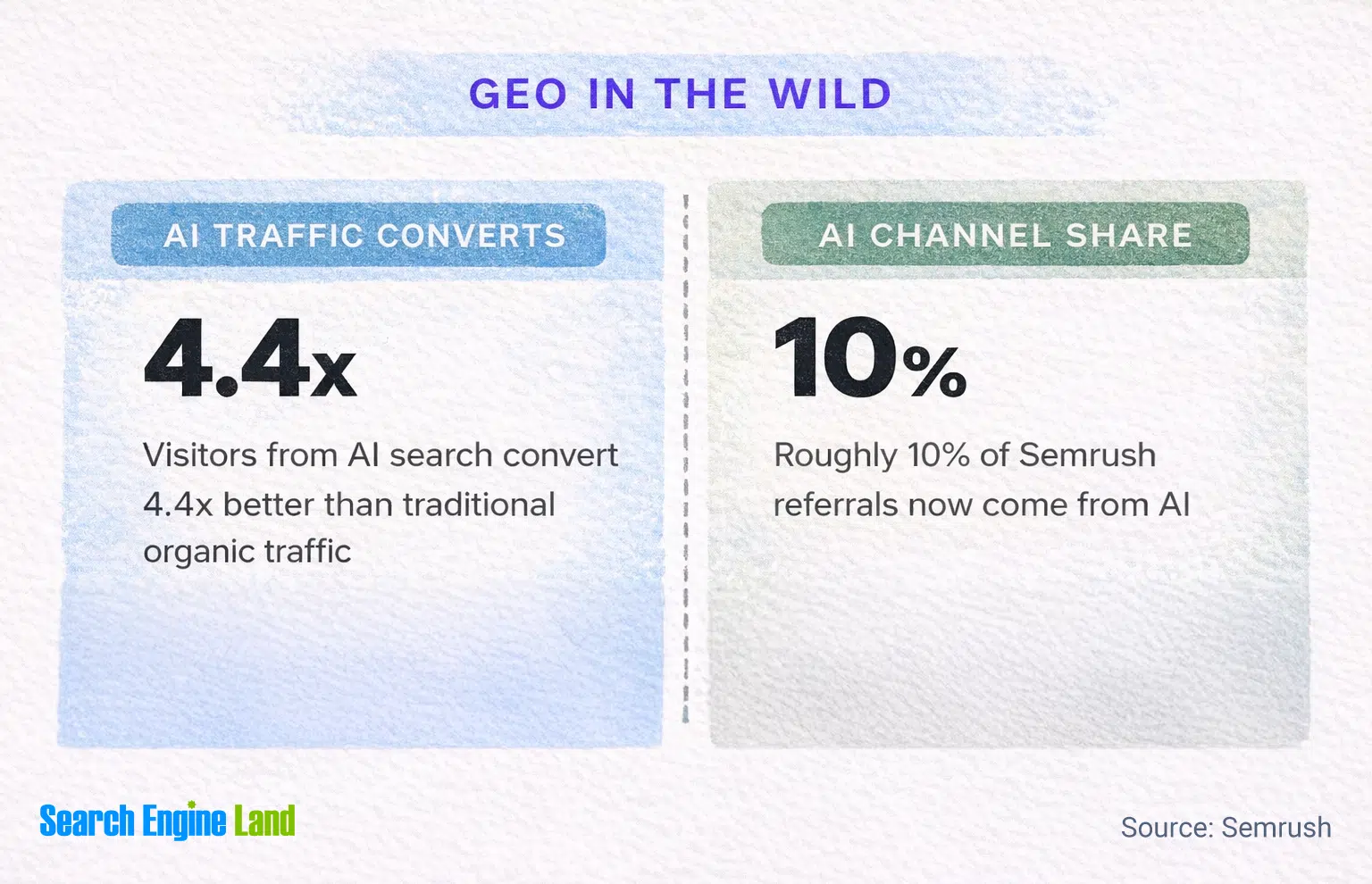
ChatGPT now has 800 million weekly active users. Google AI Overviews appear for 30% of US desktop keywords. 69% of all searches are now zero-click — the user gets their answer without visiting a website.
Here's the counterintuitive part: brands cited in AI Overviews earn 35% more organic clicks than non-cited sites. Being visible in AI search doesn't mean losing traffic — it means earning a different, higher-intent version of it. The user who clicks through from a ChatGPT recommendation has already been pre-sold. They're not browsing — they're checking.
The risk isn't that AI replaces your traffic. It's that if you're invisible in AI answers, a competitor becomes the default recommendation and you lose the customer before they ever reach a search results page.
How AI decides who to cite
AI search isn't a ranking algorithm in the traditional sense. It's a reasoning process. When auser asks a product question, the system:
- Breaks the question into multiple sub-queries (fan-out queries now average 12 words — up from 6 words just six months ago)
- Retrieves data simultaneously from training data, live web search, and knowledge graphs
- Evaluates each source for relevance, freshness, authority, and context
- Synthesises a blended response with citations
The brands included in that answer are the ones the model has encountered across multiple authoritative, consistent sources. It doesn't just look at your website — it builds a picture of your brand from everywhere it appears online.
Why your own website probably isn't enough
Research across 21,311 brand mentions in ChatGPT, Claude, and Perplexity found that 85% of brand citations in AI search come from third-party content — not brand-owned pages. Brands are 6.5x more likely to be cited via third-party sources than their own website.
Of those third-party citations, 90% come from listicles, comparisons, or review content — the "best X for Y" articles, comparison sites, and review platforms that you may have been treating as a nice-to-have.
There's a further complication: 68% of brands appear in only one AI search platform. Visibility in ChatGPT doesn't automatically mean visibility in Gemini or Perplexity. Each model draws from different training data and retrieval sources. Cross-platform presence requires deliberate breadth, not just depth on one channel.
What GEO success actually requires
Structured data and schema markup
This is the technical foundation. Product, Review, FAQ, and ItemList schema markup give AI systems structured, machine-readable signals about what your products are, what they cost, and what customers think of them. Without structured data, AI models infer your product details from unstructured text — which is slower, less accurate, and less likely to produce a confident citation.
Priority for DTC brands: Product schema with price, availability, and review rating on all
product pages. FAQ schema on category and comparison pages.
Third-party presence in listicles, reviews, and editorial coverage
Because 90% of AI citations come from comparative and review content, earning mentions in those formats is the highest-leverage GEO activity available. This means:
- Proactively reaching out to "best X" list publishers in your category
- Keeping review platform profiles on Trustpilot, Google Reviews, and category-specific sites
- Building editorial coverage through digital PR in vertical and industry publications
The goal isn't quantity of mentions — it's quality and consistency. A brand mentioned accurately and positively in 20 relevant third-party sources is significantly more citable than one mentioned vaguely in 200.
Reddit and community presence
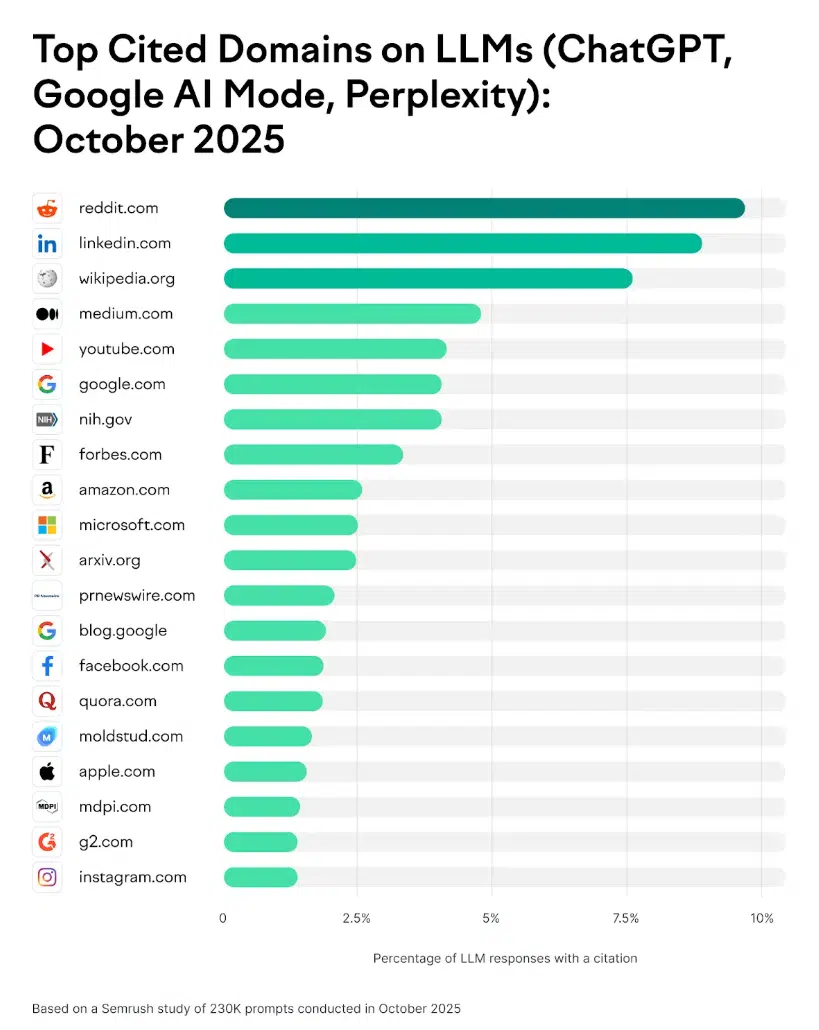
Reddit accounts for 40.1% of all LLM citations — making it the single most-cited domain in AI responses (based on Semrush analysis of 150,000+ citations). The reason is structural: AI models trust community-validated content over marketing copy, thread format mirrors how humans interact with chatbots, and Google's $60M/year data licensing deal means Reddit content is deeply embedded in AI training data.
For DTC brands, this means genuine community engagement has become a GEO signal. Answering questions in relevant subreddits, encouraging customers to share experiences, and monitoring how your brand is described in community discussions all contribute to how AI models understand and represent your brand.
Consistent brand narrative across every channel
AI builds its picture of your brand from the aggregate signal across all the places you appear. If your messaging is inconsistent — different claims on your site versus review platforms versus press coverage — the model builds a confused picture and is less likely to confidently cite you.
Keep your core brand claims, product descriptions, and differentiators consistent and
factually accurate everywhere they appear.
Technical SEO foundation
GEO is built on SEO, not instead of it. Crawlable pages, fast load times, clean URL architecture, and mobile optimisation are prerequisites. An AI crawler that can't access your pages can't learn from them. The fundamentals still matter.
How to measure whether it's working
GEO performance isn't measured in keyword rankings. It's measured in citations and brand mentions across AI platforms. Tools like SE Ranking, Semrush AIO, Otterly.AI, and Rankscale.ai let you track:
- AI visibility score — how often your brand appears in AI responses for your target prompts
- Share of voice — your citation share versus competitors across AI platforms
- Query coverage — breadth of prompts where your brand is cited
- Sentiment accuracy — whether AI is describing your brand correctly and positively
One measurement caveat: not all traffic showing in GA4 as coming from ChatGPT or Perplexity represents real users. A significant share is AI crawler traffic — Cloudflare sees approximately 50 billion AI crawler requests per day, and AI crawlers now account for over 10% of all website traffic. CDN-level analytics can help separate genuine referral visits from bot crawls, giving you a cleaner picture of actual GEO-driven impact.
What to do this week
- Ask ChatGPT, Perplexity, and Gemini the product questions your target customers
would ask. Note whether your brand appears — and if so, what it says about you.
- Check that Product schema is implemented on all product pages. Validate it in Google's Rich Results Test.
- Find the top 5 "best [your category]" articles ranking on Google. Audit whether your brand is included — and if not, who to contact.
- Pull your review platform profiles — confirm Trustpilot, Google Reviews, and any category-specific platforms are current and accurate.
- Search Reddit for your brand name and product category. Understand where the conversations are happening before you try to join them.
FAQ
Is GEO just SEO with a new name?
No — though SEO is the foundation GEO builds on. Traditional SEO optimises for clicks
from a results page. GEO optimises for citation in a synthesised AI answer. The technical requirements overlap (structured data, crawlability, authority), but the strategic emphasis shifts: you're no longer trying to rank above competitors — you're trying to be trusted alongside them in an AI response.
How long does GEO take to show results?
Comparable to organic SEO — 3–6 months to show up meaningfully in AI citation patterns.
Building third-party presence, earning editorial coverage, and accumulating consistent review
data doesn't happen overnight. The brands investing in this now will be the default citations
in AI answers by the end of the year.
Should we block AI crawlers from our site?
Only if you have specific competitive or legal reasons to do so. Blocking AI crawlers via
robots.txt removes your content from the training and retrieval data those models use. For
most DTC brands, being crawlable is an advantage — it's how AI builds accurate knowledge
about your products.



23.png)