Google will now tell you how many conversions your first-party data "recovered". Here's what that number can and can't support.
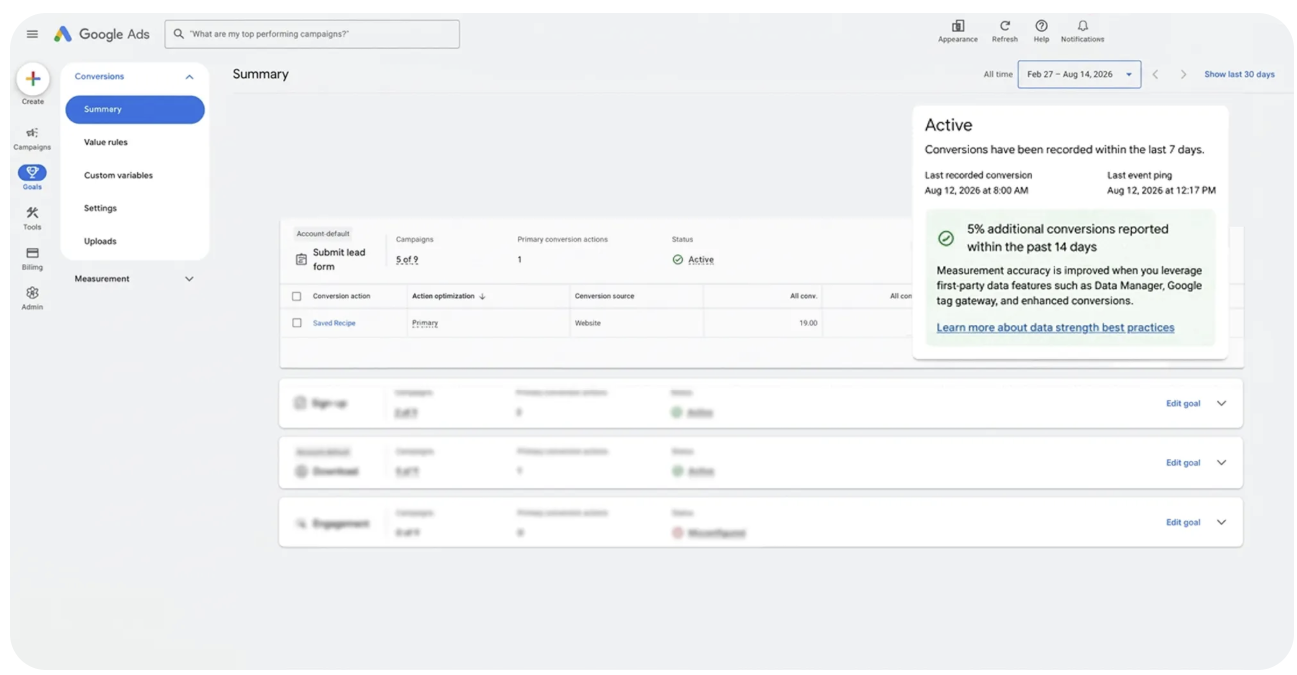
In Google's words, it "calculates the additional conversions recovered by your first-party data". The example in the announcement reads "5% additional conversions reported within the past 14 days", sitting in the interface next to the campaigns it describes.
That's a useful thing to want. Anyone who has spent the last two years rolling out enhanced conversions, consent mode, and Google tag gateway has been asked the same question by a founder or CMO: did all of that work actually change anything? Google is now offering to answer it for you.
The problem is who's answering. This is the platform that benefits when you share more data, grading the value of the data you shared, using a method it hasn't published. That doesn't make the number useless. It makes it a particular kind of number — one you should know how to read before it turns up in a board deck.
What Google actually shipped
The uplift metric arrived as part of a wider measurement release. The full list matters, because the uplift figure is designed to sit at the end of it:
- Data Manager is now inside Google Analytics and Display & Video 360, alongside Google Ads, Search Ads 360, and Campaign Manager 360. One place to connect CRM, offline, and app data.
- Enhanced conversions are launching in GA and DV360, extending hashed first-party matching beyond Ads.
- The Data Manager API is now "universal", built on the IAB Tech Lab's Event and Conversions API standard, with built-in diagnostics that Google says can "automatically identify and address data issues".
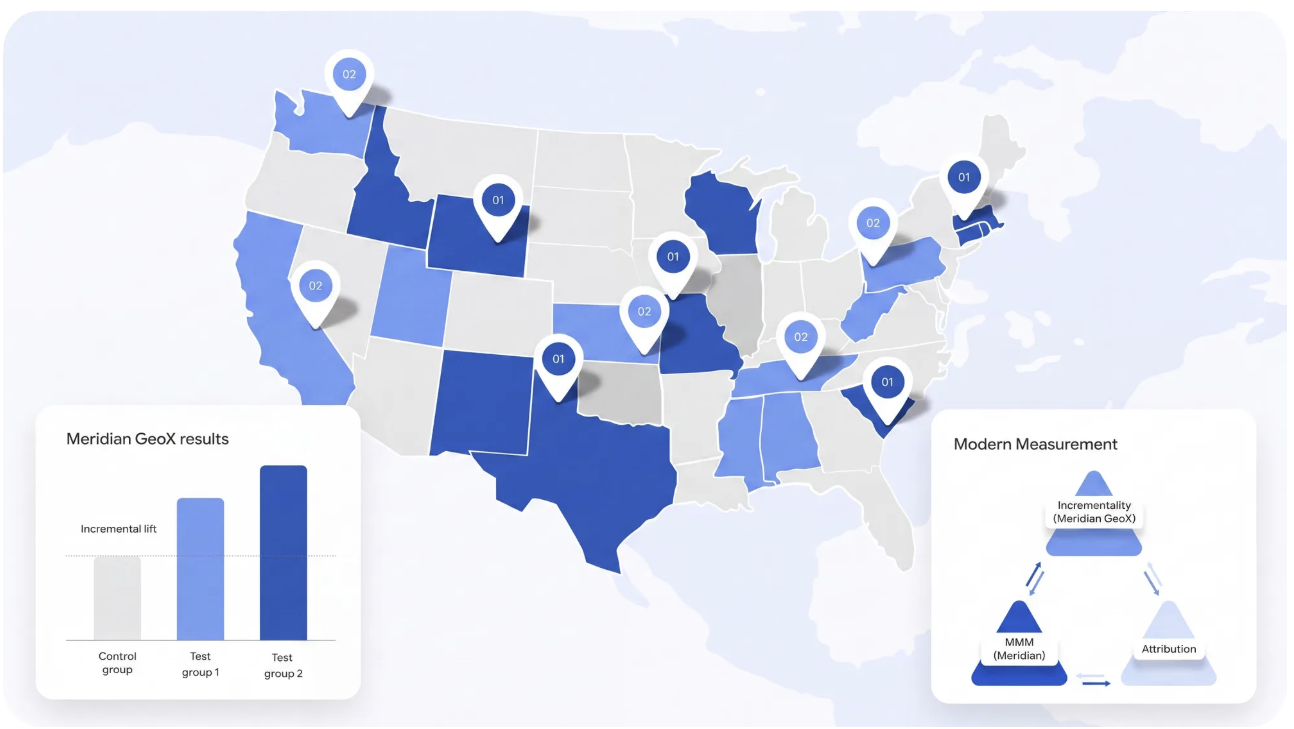
- Meridian GeoX is generally available globally — Google's geo-experiment tooling inside its open-source marketing mix model, out of beta.
- The Data Strength Uplift metric itself.
"Data strength" is not a score. It's Google's name for a four-step sequence — connect your tags and sources, enrich the signal with customer and purchase data, activate it through Smart Bidding and Customer Match, then prove it with incrementality tests or MMM. The help page for it went live in January. The uplift metric is Google putting a number on step four so you don't have to run step four yourself.That's the pitch. Here's what's behind it.
Four percentages, four different studies
Google's announcement leans on four headline figures. The footnotes are where the work is, so here they are, unparaphrased:
- 26% increase in incremental ROAS — "Search campaigns bidding to conversion value", April 2025 to April 2026.
- 11% increase in Search conversions — "standard conversion imports vs. Enhanced Conversions on imported conversions", 1 January to 14 January 2026. Two weeks.
- 14% conversion uplift from Google tag gateway — "Global, Finance, July–Dec 2024 vs Jan–June 2025". One vertical, and the same 14% Google has been quoting across its measurement messaging all year.
- Over 20% uplift for Demand Gen campaigns using tag gateway — 3 to 17 June 2026. Two weeks again.
None of these is a lie. But they are four different measurements of four different things on four different timeframes, and the announcement presents them as one story. A two-week sample from January and a year-long sample from Search bidding to value are not evidence for the same claim. The 14% figure specifically is a finance-vertical result, which is worth knowing before a DTC brand treats it as a benchmark.
The metric itself has no published methodology. Google hasn't said how "recovered" is defined, whether it's modelled or observed, what the counterfactual is, or when it rolls out to which regions. As PPC Land put it, this is "a number an advertiser cannot independently audit".
What the number can legitimately tell you
Set aside the marketing and the metric still has a real job. Three things it can support:
1. A directional read on a setup change. If you switched enhanced conversions on in July and the uplift figure moves, that's a signal the tag is matching. It won't tell you the true incremental value of the change, but it will tell you something happened — which is more than you get from watching a conversions column that's already been reprocessed.
2. A prompt to check the foundations. A low or absent figure on an account you thought was well-instrumented is a useful nudge. If Google can't find anything to recover, either your setup is already complete or something in the chain — consent mode, the gateway, the hashed fields — isn't firing.
3. Internal alignment. "Google now reports our recovered conversions and it's blank" is a more persuasive sentence to an engineering lead than "measurement best practice".
What it can't support
"Our first-party data drove X% more revenue." No. "Recovered" conversions are conversions that happened anyway and are now being attributed. A recovered conversion is a reporting gain, not a sales gain. Presenting the uplift figure as incremental revenue is the single most likely misuse, and it will happen in a board meeting near you.
A comparison between accounts. With no methodology, a 5% on one account and 9% on another tells you nothing about which setup is better. The modelling inputs could differ entirely.
A reason to feed Smart Bidding a target you can't audit. This is the subtle one. More recovered conversions means Smart Bidding sees more conversions, which changes what it thinks your true CPA or ROAS is. If the recovery is partly modelled, you're now bidding to a number that includes an unaudited estimate. That may be fine. It may not. You should at least know it's happening.
How to sanity-check it yourself
You don't need Google's methodology to test whether the number is telling you something real. You need a before-and-after that isn't run by the platform.
Pick one change, one date. The cleanest test is a single setup change — enhanced conversions on, or tag gateway live — on a known date. If you rolled out three things in one week, you have no attribution.
Compare Google Ads conversions to a source of truth. For ecommerce, that's platform orders. For lead gen, that's CRM records. Take the four weeks before the change and four weeks after. If Google Ads' conversion count moves closer to your source of truth, the recovery is real. If Ads' count rises but orders didn't, and the gap to your source of truth widened, you've recovered attribution, not revenue — which is still worth having, but call it what it is.
Watch conversion lag. Recovered conversions often arrive late. Don't read the first week.
Check what Smart Bidding did next. If CPCs rose in the weeks after the uplift appeared, bidding has reacted to a richer conversion feed. That's expected. Decide whether the new spend level is one you'd have chosen.
Keep your own record. The example Google shows covers 14 days. It won't build you a history; log it weekly.
What to do this week
- Find whether the metric has appeared in your accounts. Google hasn't published the rollout schedule or the interface location, so this is a manual check.
- Write down your current conversion-count gap between Google Ads and your source of truth, before you change anything. That's your baseline.
- Finish one thing. If enhanced conversions or tag gateway is half-implemented, complete it on a single dated change so you can attribute any movement.
- Brief whoever reads your reports on the difference between recovered and incremental before the number appears in front of them. It's a five-minute conversation now or a much longer one later.
- Treat Google's four percentages as four separate studies, and don't quote the 14% unless you're in finance.
FAQ
Is Data Strength Uplift the same as incrementality?
No. Incrementality measures conversions that wouldn't have happened without the ad. Uplift measures conversions that did happen and are now being reported. Google offers the first through Meridian GeoX and conversion lift studies; this metric is the second.
Where does the metric appear?
Google hasn't said. The announcement shows it beside campaigns in Google Ads, but names no rollout date, region, or navigation path.