Search Console's AI performance report shows impressions, not clicks. Here's what it can and can't tell you
Google's Search Console AI performance report went global on 31 August. It shows impressions, no clicks and no queries — here's what you can honestly conclude.
Google finished rolling out the Search Console AI performance report to every property worldwide on 31 August 2026. It tells you how often your pages appeared inside AI Overviews and AI Mode. It does not tell you how many people clicked, and it does not tell you what they searched for.
Most of the coverage stopped at "it's live". That leaves the more useful question untouched. Given impressions with no clicks and no queries, what can you honestly conclude — and which conclusions will get you into trouble in front of a founder?
What the report actually contains
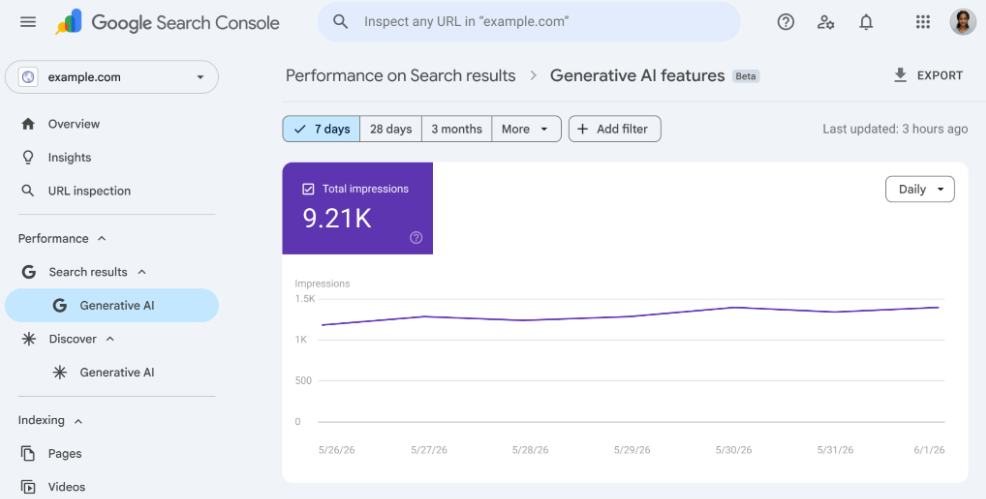
Google introduced the generative AI performance reports on 3 June 2026 and rolled them out in phases before completing the global rollout on 31 August. There are two: one for Search, one for Discover. Both cover AI Overviews and AI Mode.
One metric: impressions — how often links to your site were shown inside a generative AI feature. Four dimensions: pages, countries, devices, and dates, with granularity from hourly to monthly in Pacific Time.
No clicks. No click-through rate. No queries. No average position. Search Labs experiments are excluded, and the most recent days are preliminary and will move.
Two counting rules are worth knowing before you read a single number:
- Impressions are counted at property level. If two results from your site appear in the same AI feature, that is one impression, not two. The same URL appearing in both an AI Overview and the blue links below it is also one impression.
- In AI Mode, a follow-up question counts as a new query. A single conversational session where someone asks three follow-ups can generate three impressions. Some of your impression growth is a description of how people use AI Mode, not how visible you have become.
The part most write-ups missed: this is not new data
The report is a filter over data you already had. Google's own documentation says the generative AI report includes data from the Web search type in the standard Performance report, and Google has confirmed that AI impressions were always counted in your overall totals. Your aggregate numbers did not change on 31 August. Nothing was added.
The more important half of that is rarely stated plainly: the clicks were already counted too. When someone clicks an external link inside an AI Overview or an AI Mode response, that registers as a click in your standard Search performance report. It always has.
So the clicks exist in your data. They are simply not separable from everything else.
That has a hard consequence. You cannot calculate an AI Overviews click-through rate. You also cannot subtract AI impressions from your totals to derive a clean "traditional search" CTR, because the impression side splits and the click side does not. The two halves cannot be reconciled with what Google gives you.
If a report lands on your desk this month quoting an AI Overview CTR for your site, it came from a third-party estimate or a modelled sample. It did not come from Search Console, and it should not be presented as though it did.
Three things you can legitimately conclude
1. Which of your pages get cited
The pages dimension is the most valuable output in the report. Export it and compare the cited set against your twenty highest-value commercial pages. Where those two lists diverge, you learn something concrete: the format of content Google's AI features are willing to pull from your site is not the format you have been prioritising.
That is an editorial instruction, not a vanity metric. If your cited pages are all guides and none are category or comparison pages, you know which template needs the self-contained, quotable answers.
2. Whether citation is growing or shrinking
Trend, not absolute value. Hold the page set constant and compare month over month. The absolute impression count is affected by AI Mode follow-up behaviour and by how far AI features have expanded across your query set — neither of which is about you. The direction of travel for a fixed set of pages is still a real signal.
3. Which markets are affected
The country dimension matters if you run multiple markets. AI feature coverage has not expanded evenly, and knowing whether your best-performing market is the one where AI features have taken over the SERP changes how urgently you act.
Three conclusions the report cannot support
"AI Overviews are costing us traffic"

This is the one that will be attempted most often, and the report cannot show it. There are no clicks in it. Putting rising AI impressions next to falling sessions on the same chart produces a compelling slide and no evidence. Impressions rise when AI features expand across more of your query set, which is a change in Google's SERP composition rather than a measurement of clicks moving anywhere.
The honest version of that claim still comes from the standard performance report: click-through rate falling while average position holds. That comparison is imperfect, but it uses clicks, which is more than the AI report can offer.
"This page is worth prioritising because it gets AI impressions"
No query data means you do not know what surfaced the page. A page picking up impressions on informational queries with no commercial intent is a different asset from one being cited on comparison queries, and the report will not distinguish them for you.
"Our AI visibility is up 40% — the vendor tool agrees"
It does not agree, because it is not measuring the same thing. Third-party AI visibility tools sample prompts and record whether your brand is mentioned. Search Console counts impressions of your URLs inside Google's AI features. Different definitions, different sampling, different surfaces. Put them in the same report if both are useful, but label them separately and never average them.
The opt-out control, and why the default is right for almost everyone
Google shipped a Search generative AI control alongside the reports. It lets a site owner decide whether their content appears in, and is used to ground, Google's generative AI features.
The trade-off is exactly what it sounds like. Opt out and you receive no impressions and no traffic from those surfaces. Google states the choice is not a ranking signal for ordinary web search results. Before this existed, the only levers were the nosnippet and max-snippet robots directives, which do apply to AI features but also strip or truncate your ordinary search snippets — a genuinely blunt instrument.
Who it is for: publishers with a content licensing position, or sites where reproduction of the content is itself the commercial risk. If you sell products or generate leads, opting out removes a surface you currently appear in for free, in exchange for nothing. Leave it alone — and if you do have a reason to use it, check the current Search Console documentation first, because the precise implementation has been described inconsistently across coverage.
What to do with this in the next week
- Export the pages report and compare it against your top twenty commercial pages. The gap is your content brief.
- Set a baseline now, on a fixed page set, so that the month-over-month trend means something in October.
- Change what you report upward. Replace any "AI CTR" line with citation presence and its direction of travel, and say plainly that clicks are not separable.
- Keep tracking CTR at stable position in the standard performance report. It remains the best available proxy for AI-driven click loss, and it is the only one with clicks in it.
- Leave the generative AI opt-out alone unless you have a licensing reason to use it.
The report is a real improvement on having nothing. It is not a measurement of what AI search costs you, and the fastest way to lose credibility in a board meeting is to present it as one.
Frequently asked questions
Does the AI performance report show traffic I was not seeing before?
No. Both the impressions and the clicks from AI Overviews and AI Mode were already included in your overall Search performance totals. The new report isolates the impressions. It does not add anything.
Will Google add click data later?
Nothing has been announced. The UK's Competition and Markets Authority has been expecting click-through data as part of its work on Google's search remedies, so there is external pressure, but the August updates did not mention click reporting.