Snapchat’s Commerce Power Pack adds DPA in Chat plus value and third-party optimisation betas. Use this checklist to prepare catalogue, measurement and tests before peak.
Snapchat’s Commerce Power Pack adds DPA in Chat plus value and third-party optimisation betas. Use this checklist to prepare catalogue, measurement and tests before peak.
Snapchat Commerce Power Pack is Snap’s September 2026 performance bundle aimed squarely at holiday shopping. Announced on 10 September on Snapchat for Business, it combines Dynamic Product Ads in Sponsored Snaps inside Chat with a set of optimisation tools (Value Optimization in beta, Third-Party Web Optimization in open beta, Omnichannel Optimization in alpha). Trade coverage through mid-September framed it as a “spend smarter” push for the US and UK.
If Meta still takes the majority of your paid social budget, that is fine. The useful question is narrower: which parts of the Snapchat Commerce Power Pack are generally available now, which are beta, and what must be true in your catalogue and measurement stack before you waste a learning budget in October.
What shipped (and what is still experimental)
Generally available now
- Dynamic Product Ads for Sponsored Snaps in Chat. Catalogue-driven product ads in Chat, described by Snap as its most-used surface (Snap cites survey data that 85% of Snapchatters use Chat regularly; that figure is stated preference research, not observed behaviour). Global advertisers can use it.
Beta / alpha
- Value Optimization (beta, web and app): optimise toward ROAS and higher-value purchases; can be used with Unified Attribution.
- Third-Party Web Optimization (open beta, web): combine first- and third-party signals to optimise toward third-party purchase outcomes (Snap cites partner tests with Google Analytics and Northbeam; treat those as Snap-reported study results, not independent guarantees).
- Omnichannel Optimization (alpha): capture web and app purchases in one campaign based on where conversion is likelier. Least mature; no general release date in the announcement.
Snap also cites TransUnion MMM work positioning Snapchat on speed-to-conversion and indexed ROAS versus other channels, plus an internal DPA study claiming a 22% improvement in 7-day CPA for Pixel Purchase-optimised DPA (July 2026 internal test). Use those as directional vendor claims. Do not paste them into a board deck as your forecast.
Why Chat DPA is the part to act on first
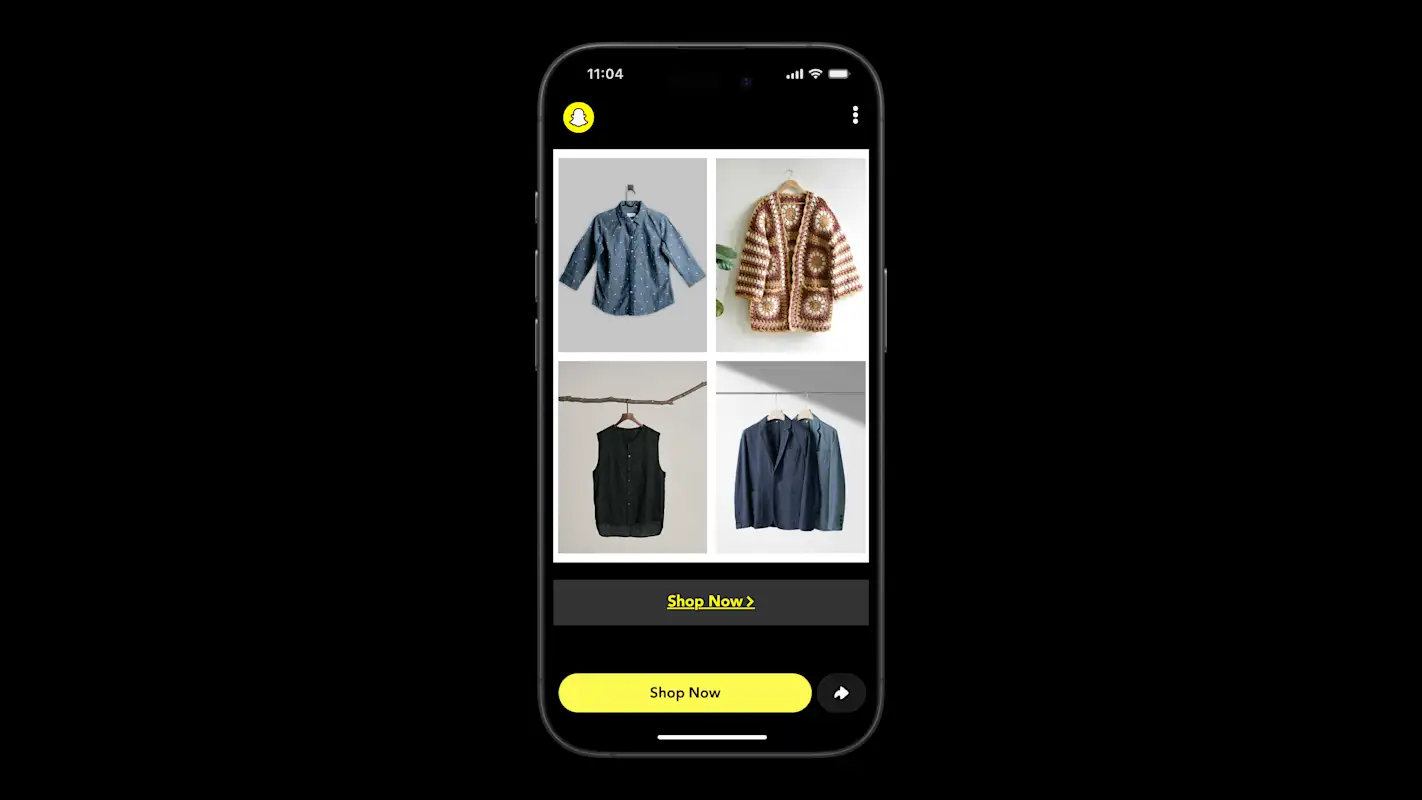
Practical implications:
- Creative constraints change. Chat placements favour speed, clarity and product truth over long storytelling. Feed assets that rely on sound-on hooks may under-transfer.
- Catalogue quality becomes the creative. Titles, primary image, price accuracy and availability will decide whether AI recommendations look trustworthy in a conversation context.
- You need a clean product set. Dumping the entire catalogue into Chat DPA without exclusions for low-margin, out-of-stock or non-giftable SKUs is how you buy regret in November.
Treat Chat DPA as a product-discovery-to-action layer for younger shoppers already in Snap’s graph, not as a brand channel replacement for Meta or YouTube.
Setup checklist before you spend
1) Catalogue and merchant centre hygiene
- Confirm product feed sync frequency (daily is a minimum going into peak; near-real-time if you can).
- Strip or exclude: out of stock, pre-order ambiguity, adult/restricted if policy-sensitive, ultra-low margin clearance you do not want accelerated.
- Standardise title patterns: brand + product + key attribute. Chat ads leave little room for cleverness.
- Validate image: white or clean background, readable on mobile thumbnails.
- Map custom labels for: margin tier, giftability, hero vs long tail. You will need them when Value Optimization becomes available to you.
2) Measurement before optimisation betas
Do not request Value Optimization or Third-Party Web Optimization until the basics are boringly correct:
- Snap Pixel (or equivalent) firing on purchase with value and currency
- Deduplication rules understood if you also use CAPI-style server events
- Offline or delayed purchase paths documented (especially if retail pickup matters)
- A decision on which “source of truth” you will judge Snap against (platform-reported, GA4, Northbeam/Triple Whale, MMM). Third-Party Web Optimization only helps if that third-party signal is stable
3) Campaign architecture for a first test
Keep the first flight simple:
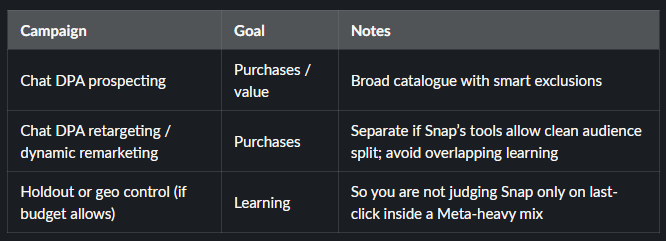
Budget guidance: fund a real learning sample, not a token £20/day that never exits learning. Exact thresholds vary by AOV and market; agree a 2-3 week test window with a pre-written kill/scale rule.
4) Creative and offer rules for Chat
- Lead with product + price + one proof point (rating, “in stock”, delivery promise)
- Prefer single-product clarity over carousel complexity until you have delivery volume
- Align landing pages to mobile checkout speed; Snap traffic that lands on a slow PDP will look like a media problem when it is a site problem
- If you run Meta Advantage+ heavily, do not clone Meta UGC scripts into Chat. Intent and UI differ
How to evaluate the optimisation betas without self-deception
Value Optimization: useful when AOV and margin vary widely and you already pass reliable order value. Useless if every conversion is passed as the same flat value.
Third-Party Web Optimization: useful when platform ROAS and your MTA/MMM toolkit chronically disagree and you trust the third-party purchase definition more for cross-channel decisions. Confirm open beta access; do not assume every UK account sees it on day one.
Omnichannel Optimization: watchlist only while it is alpha. Do not build the Q4 plan around an alpha.
When Snap publishes partner lifts (for example, lower third-party CPP / higher third-party ROAS in its GA and Northbeam tests), ask: same category as you, same attribution window, same promo intensity? If you cannot answer, file the claim under “interesting”, not “forecast”.
Where Snap fits beside Meta this Q4
A sane mix for many UK ecommerce brands:
- Meta: scale and creative diversity pressure (already a live industry theme; Stellar has covered Andromeda-era creative diversity separately)
- Snap: incremental reach into younger cohorts plus Chat product discovery, measured on blended new-customer cost, not isolated last-click ROAS alone
- Search/Shopping: capture high-intent demand the social graph cannot manufacture
The Commerce Power Pack does not make Snap “the new Meta”. It makes Snap easier to run like a commerce channel if your feed and measurement are ready.
Actionable close
This week:
- Read Snap’s Commerce Power Pack post and list which features you can see in Ads Manager today versus which require beta access.
- Run a 48-hour catalogue audit focused on Chat suitability (image, title, stock, exclusions).
- Write a one-page test brief: hypothesis, budget, success metric (include a blended or incrementality view), kill criteria, owner.
- Only then apply for Value Optimization or Third-Party Web Optimization if purchase value tracking is clean.
Snapchat Commerce Power Pack is a holiday toolkit, not a strategy. The brands that benefit will be the ones that treat Chat DPA as a catalogue problem first and an auction problem second.
FAQ
Is DPA for Sponsored Snaps available in the UK?
Snap’s announcement states availability for global advertisers. Confirm placements and policy eligibility in your own account before planning spend.
Should I pause Meta to fund this?
Usually no. Fund a contained Snap test from growth budget or a small efficiency tax on Meta prospecting, then scale only if blended CAC or incrementality supports it.
Do I need Unified Attribution first?
Value Optimization can be used with Unified Attribution per Snap. If you are app-heavy, review Unified Attribution status before stacking betas.